> Development > Environment Pollution


Deus et natua non faciunt frusta: God and nature do not work together in vain
BaghjanVillage still persists albeit with a calamitous axiom.
Crossing the K Truss (Through Type) bridge above the iconic Maguri-Motapung wetland, an international bird area (IBA) in north Tinsukia district, is a well paved road.
Plying ahead on the asphalt a public work department (PWD) road sign with distinctive red rectangular borders says Baghjan in Assamese.
With few months until the six-year completion of the 2020 Baghjan gas blowout disaster and the subsequent fire that raged on for six months for the village’s already battle-weary lot hope and uncertainties move in unison influencing their attempts to ‘move on’.
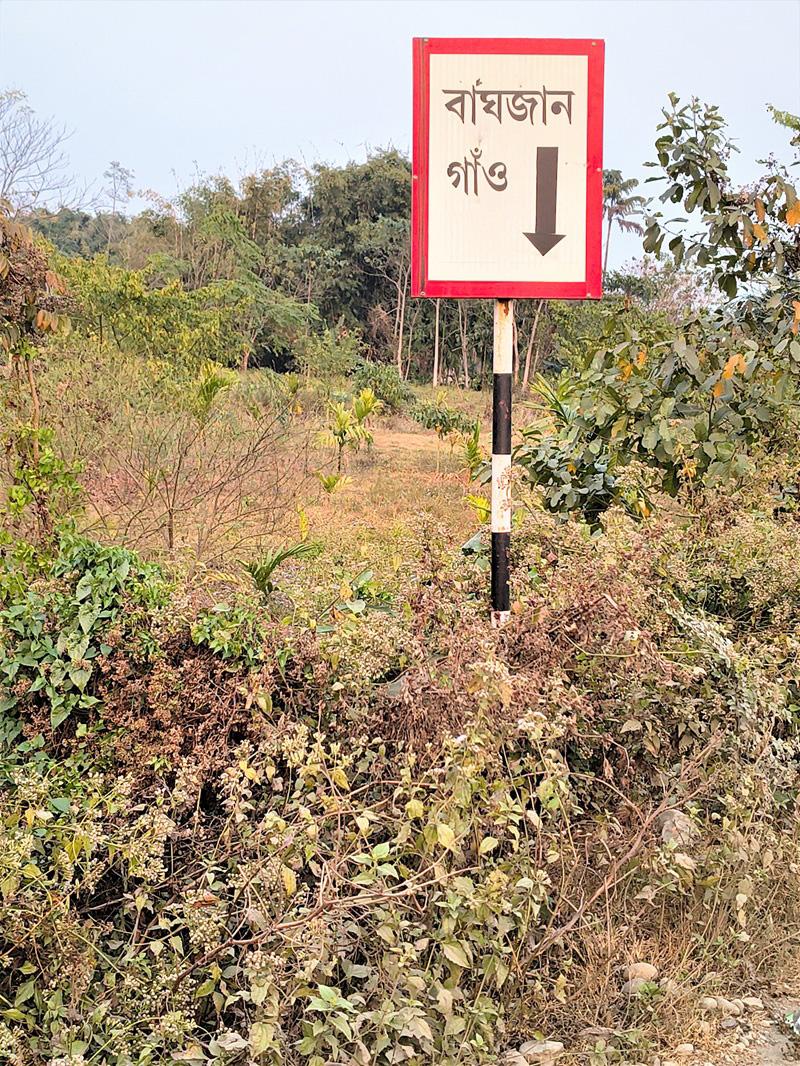
Photo : Gaurav Das
Baghjan village personifies a western Assamese village. Silent and rhythmically wrapped in sylvan drapes, patches of dried out paddy fields clothed in straw spanning across out here. Onset of a nearing faagun sun crisped the farm patches.
The media blitzkrieg has long evanesced and so has overall concerns with a wary expression corroborating ‘what transpires next’ etched on the faces of the victims three months until the six-year completion of what has been, “ascribed as one of the biggest onshore gas blowouts in the world in terms of the magnitude and complexity”.
The asphalt then bends ahead. A rectangular iron gate appears on the left side. Strung over the grills of the unpolished iron gate are two signboards.
On the right side of the grill ‘Janoni’ or notice in Assamese was written prominently in red. The other signage less prominent in size reads as, BGN#5.
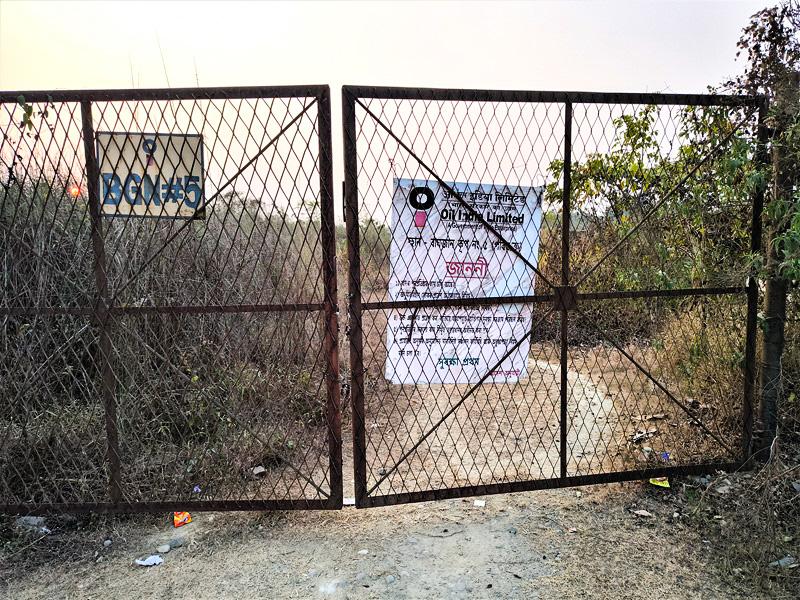
Photo : Gaurav Das
The signs solidify the gate’s responsibility. And it has to. It steadfastly deters ‘curious eyes’ to trespass onto the 9.107426 acres (or 27.55 bighas) of land comprising thick thorny bushes and waist-height shrubs.
A stone’s throw away from this bend are clusters of villages. Small-RCC type houses. The first house (to be hit) just around on the right side of the road is the property of Labanya Saikia.
Labanya and her fellow-severely impacted victims and their properties alone, all came within that impact zone owing to their close living proximity to BGN#5.
The gate guards BGN Well 5 or BGN 5. That ominous well #5 has been since “killed” but the ‘chest-height welded iron bars may guard the silent abyss presently but the sleepy deep chasm in dark shadows below dictates a past itself, “as the epicentre of a gas blowout” and Baghjan Village, a collateral.
Labanya with her native eastern Assamese equanimous twang points her hand at the two signs by the road’s bend.
“That is from where the black rains began pouring down mercilessly. We were all covered in matter that remains beneath mother earth,” she said to this reporter.
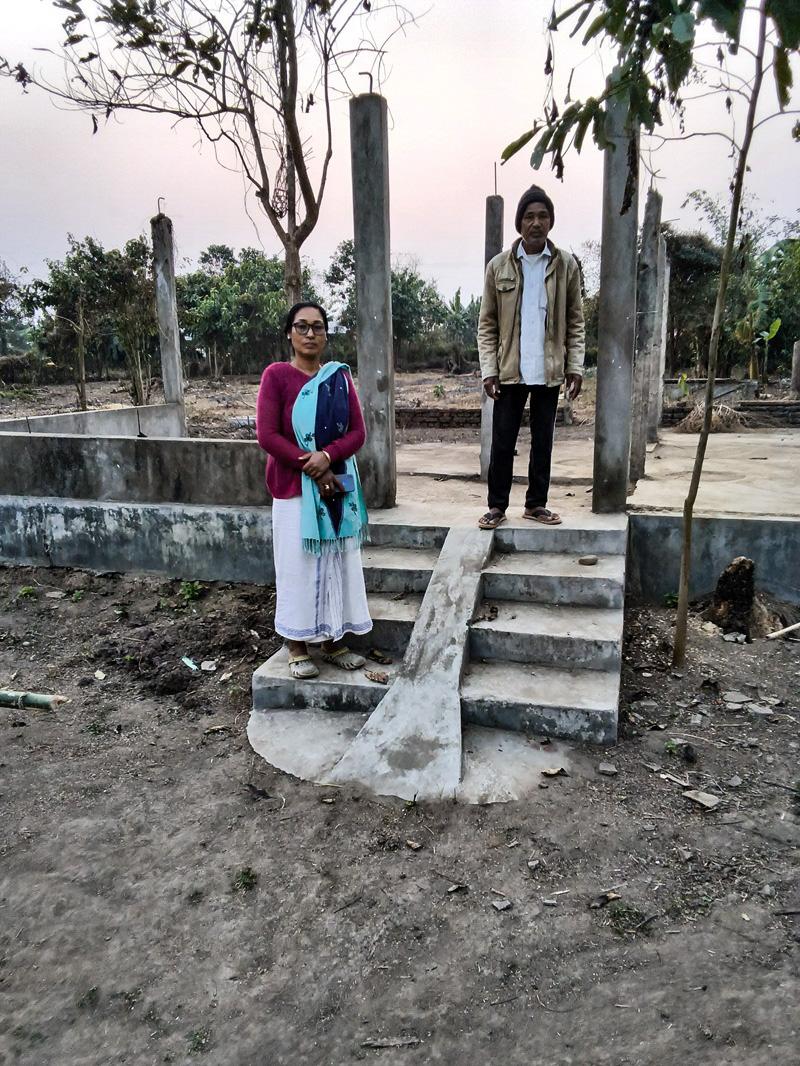
Photo : Gaurav Das
It was exactly here on that decisive day of May 27 around past 10:30 am when BGN Well No. 5 (an active oil and natural gas reservoir) began to sprout out condensates that had remained coiled underneath the depth of 12696.85 feet (3870 meters) until that day.
Earlier, BGN#5 was producing around 1 lakh standard cubic metre per day or SCMD from the aforementioned depth alone.
That day the standard land-based drilling rig had penetrated deep into 12234.252 feet (3729 metres) whilst operating from a “new sand (oil and gas bearing reservoir)” when human machinations and endeavours inadvertently caused an immediate upheaval for the sleepy Baghjan village, its villagers and the adjacent Dibru-Saikhowa National Park (DSNP including the Maguri-Motapung beel).
BGN#5 sits 300 metres or 0.3 kms from the boundary of the buffer forest of DSNP, and 900 meters or just 0.9 kms from the core area of DSNP.
All organic entities along with the surrounding ecologically fragile vistas instantly became cocooned in collateral damages ushered by inorganic agencies ushered at first by noxious odorant enveloping the surrounding air and then by condensate matters.
What burst out from BGN#5 all coalesced blanketing everything within 3.8 square kilometres of its impending grasp.
Scientific data which were later collected and studied upon revealed that 50 percent of the condensate matter were “assumed to have fallen within 300 m radius”.
Fragments from that cataclysmic blowout and the explosion the traces and the stains (both tangible and intangible) that it left behind can be anything but invigorating and still yet alive
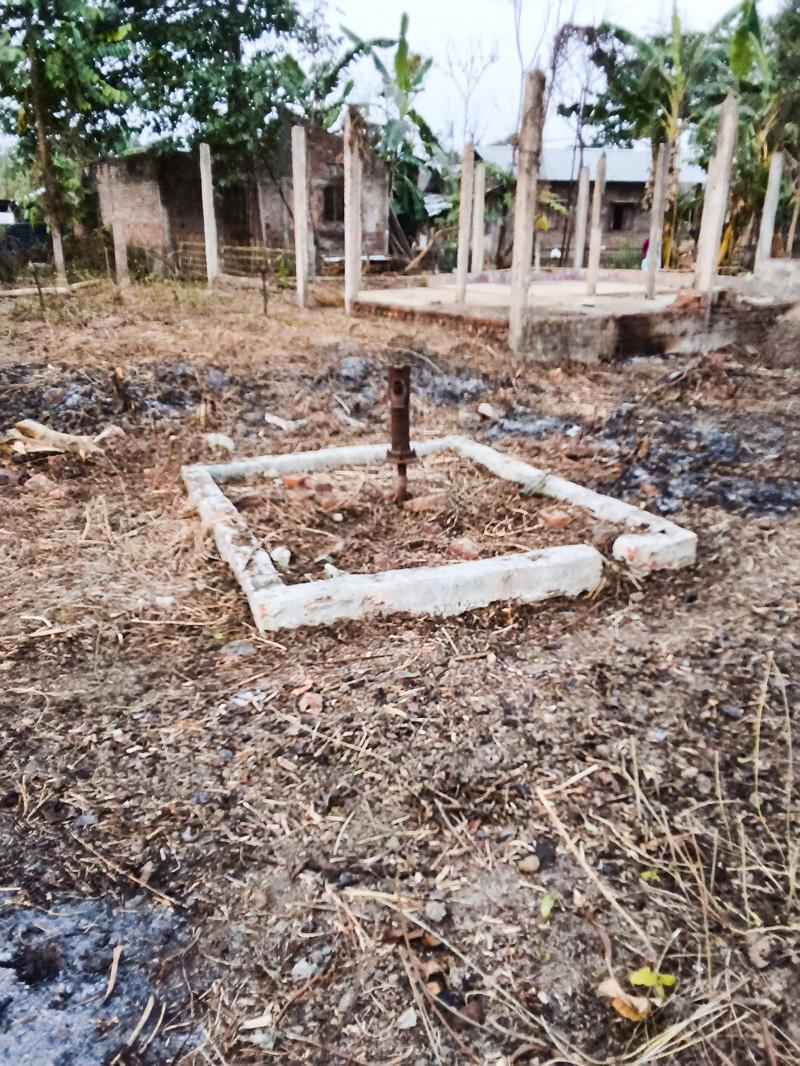
Photo : Gaurav Das
Experts later cited the blowout alone generated “64000 kgs of condensate released during blowout prior to explosion”.
In real time calculation Labanya, her children and her kin were all sitting ducks on that fateful morning of May 27, 2020. They had all absorbed in their skin pores and inside their breathing systems condensate from hydrocarbons.
Labanya and her family comprising her in laws’ remains one of the most directly affected families of the disaster.
A 40-year-old widow and a “categorized severe victim” Labanya was placed among 11 others in Category 1 with accentuated damages incurred on account of the unstoppable gushing of kuan#5 as she refers to BGN #5.
From the entrance’s façade the onslaught of the gushing takes few minutes to take account for. The kuan’s ravaging acts are smeared across in the backyard, a “real deal is what Labanya described as the touchings of a disaster.
This humble RCCesuqe accommodation without any exterior paint is what she constructed with the first interim compensation (not the final) she received some years ago. BGN # 5 paid her the interim compensation after “she lost all earthly possessions”.
She told this reporter, “Post covid-19 the value of ?25 lakh/ means paltry. With that portion of compensation, a major chunk was spent on mortar, cement, sand, raw materials, labour etc. There was nothing else to do. This was the last resort for my children. #5 kuan robbed us of everything. Our houses and whatever we owned.”
Labanya, a petite and medium sized in physical stature with a deep equanimous eastern-Assamese intonation when asked by this reporter about the aftermath of the disaster’ the present-day impact on her, her children’s, and her fellow victims’ lives, and in the present political context with state assembly elections just around the corner.
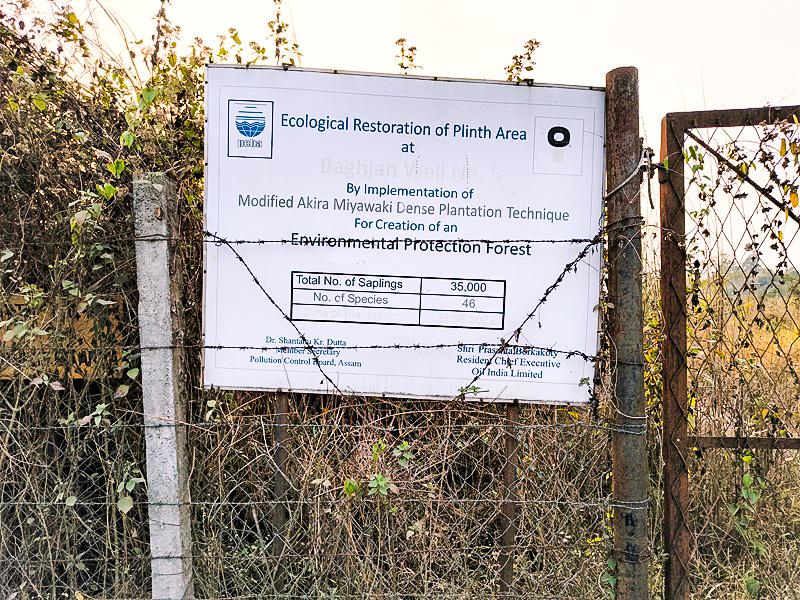
Photo : Gaurav Das
“Does Baghjan has the potentiality to be an election issue. Is the twenty-five-lakh amount an insurance policy securing my kids’ future,” she quiped when asked.
She lost her husband some years prior to the gas blowout. Left to fend-off alone with three of her children Labanya’s humane endearing for a secured future was arrested because of that kuan 5. The ordeal back then only surmounted.
An almost regimental-type dwelling for a gruelling eleven months at a relief camp some distances away where she and her fellow worst affected victims were ‘assured’ by politicians from across the aisle and by OIL.
To avoid her three children of burgeoning hardships of a makeshift relief camp she had them located at a kin’s home.
“The big names in Assam politics were all seen here at that time period. Now no one’s bothered now. People think everything’s back to square one with normalcy seeping in substantially but only I and the prioritized victims who faced the wrath of the tragedy knows quite well that we’re doing to the best of our possibilities to cope with the aftermath, but rest of Assam should know we’re all surviving and not living. Maybe they have forgotten us (people and politicians),” said Saikia.
A small squared shaped wooden roadside kiosk or ‘gumti’ lays adjacent to her property’s entrance. A kiosk of such stature sells cigarettes, betel leaves and nuts, potato chips, small and miscellaneous household items functioning as a wholesome village corner shop.
That gumti is Labanya’s sole economic sustenance apart from the remaining amount of OIL’s interim compensation that she and her victims await.
Labanya and her three children were sipping tea when exactly at ten thirty an ear-splitting, thunderous sound rendered them immobile for a few moments.
A bright summer day metamorphosized into a gloomy atmosphere. The green of that location’s topography deliquesced into a sinister fog. Then, a pungent, almost skunk-like odour lingered in the air, engulfing the villagers’ already flaring nostrils.
The sound emanated into a shockwave followed by the obnoxious smell of oil and gas condensates. Then came the black rain. Labanya said the rain if it may be called so was blackish that it resembled a total solar eclipse. Oil slush splattered all over. The cluster of villages surrounding the vicinity were all wrapped and draped in oil.
The villagers already nonplussed over the chain of events gathered near the gated site at BGN # 5. What greeted their eyes attenuated their already depleting clutch of resilience, and their fleeting chances at grasping a loose anchor.
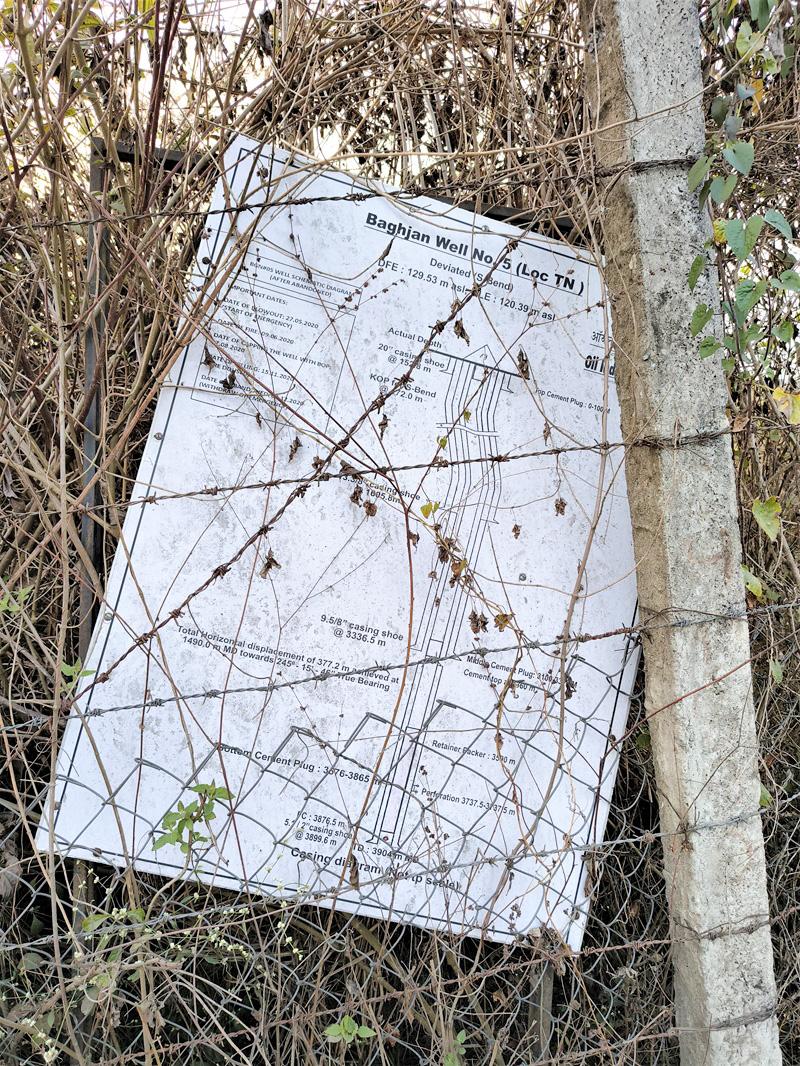
Photo : Gaurav Das
Detailed study carried out much later especially by the report titled “Ecology and Economy: Lessons Learnt from Baghjan Blowout” by MK Yadav, a retired IFS, which was released in June 2021 had this to say in the chapter ‘Understanding the Baghjan Blowout’. It said:
“The supersonic flame has a lift-off height of 11 m, and an estimated flame height of 108 m” (sic).
Shocked, and then battered by the rapid dominance of descending adversities Labanya’s coping mechanism, already reeling and not comprehending to the >75 dBA of the blowout her ears were being attuned to, collided against the laid-out rubble and debris of her late husband’s erected RCC houses.
Yadav’s detailed study states as such:
“Acoustic power of the flame=160 dB; Noise level at 500 m from the flame = 61 to 68 dB” (sic).
Nauseated with a warped and pounding disorientation ushered by the blowout’s deafening combustions screeching like a hunted prey the rumbling down of her two houses deflated her immediate dreams for her children’s happy prospects.
Her feminine in-built coping mechanism that was already reeling and being attuned to the combustion’s deafening hisses collided savagely against the very rubble and debris fell at her feet from the two modest RCC structures. Six years later her very coping mechanism is still at test and is rallying against all the colliding agents of life’s unpredictable vicissitudes.
“It was basumati who vomited black oozy substances on us that day. I reached the backyard of my property. The two houses that my late husband had constructed were in utter ruins. The green vegetation that adorned the villages was violated by the oozing substances. There was no green or emerald. It was all pitch black as if underworld creatures began their invasion on the surface dwellers,” said she.
Pausing a moment then she continued, “The gratuitous fear then began its silent invasion. Pandemonium ensued. The villagers ran hither thither. I felt it at that exact moment that we’re finished for good. Everything materialistic that I owned simply vaporised in front of my bare eyes. After the blowout we all though the worst is over. But we were all wrong when on June 9 kuan 5 exploded. This was an insult to our injuries.”
Sharing his reminisce about his ordeal was Deep Saikia the widow’s brother-in-law. A septuagenarian he described the moments when they returned home after months in a shelter camp.
“When we returned back home or allowed to our entire property appeared barren. The entire village reeked of gas and there were huge blots of oil stains all over. We couldn’t drink water. It reeked gas and tasted oil. That kuan changed our destiny and it ate our ancestral vegetation of big jack fruit trees. Our health began to change. Stomach ailments became frequent soon after. Even after some years our local farm produce bears no proper yield,” said he.
Accentuating the impact on the villagers Labanya then added, “Earlier, young men engaged in farming to make ends meet. Today we’ve seen most of the young men resorting to hajira kaam or as petty-wage labourers. To prevent further uncertainties OIL and the state government should lay emphasis on our final compensation. They should adhere to my late husband’s wish of securing his kids’ future.”
Baghjan (bagh denotes a Tiger and jan a stream) remained ensconced within its agrarian cocoon until its adjoining consort some 11. 9 kms. toward the north affixed to the Brahmaputra, the once-designated Biosphere Reserve of Dibru-Saikhowa piqued the niched naturalists’ instincts world over when it was declared a national park in 1999.
Though tourists’ flow remained nascent back then answer-seeking eyes of conservationists and preservationists began to perch themselves by the Lohit’s and Siang’s confluence.
Seven years after its transition from a biosphere reserve to a thriving 340 square kilometres of national park OIL struck gold in 2006 when it began drilling at BGN #5. A successful “drilling on target” was completed on March 12, 2007.
Reports suggest there may be between 21 and 22 active wells four pertaining to natural gas alone.
In a 2021 Civil Appeal submitted in the Supreme Court it was stated as:
“The region around DBSR is a hotspot of oil and gas production in Assam. In Baghjan alone 31 wells have been drilled for hydrocarbon exploration by OIL-around 8 wells are located within 2 km boundary of National Park” (sic).
Jayanta Gautam, a sexagenarian residing in neighbouring Doomdooma, who is a local observer, and a writer told this reporter about Baghjan and her trajectory from a sleepy village living within close proximity of a former biosphere reserve and then a national park, and then with OIL’s commencement of commercial drilling of hydrocarbons.
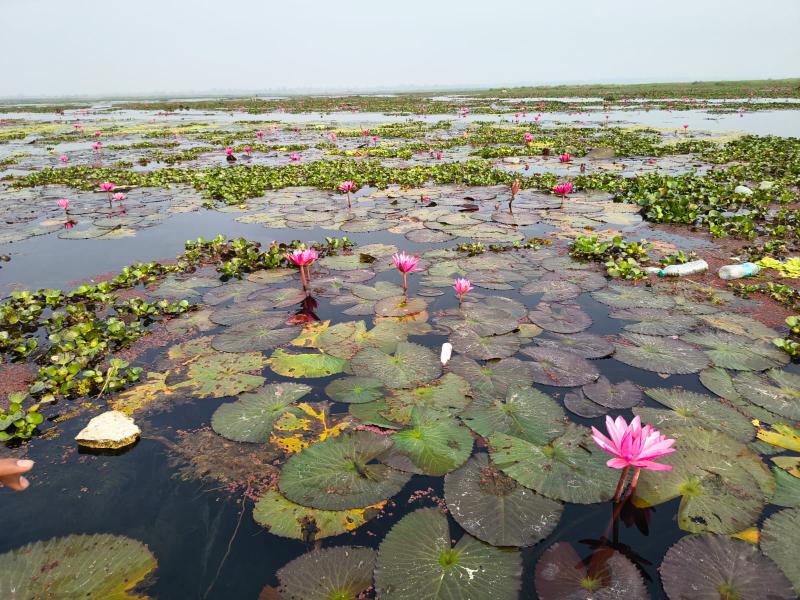
Photo : Gaurav Das
“The bridge over the Maguri-Motapung beel was called Kaliapani ghat. Before OIL’s intrusion into Baghjan’s soil for drilling and exploration it was a sleepy village. It was the last Moran community village in the south bank of the Brahmaputra. It was an old traditional route for local and adjoining communities. The wells here have the highest concentration of hydrocarbons. Few months prior to the blowout a pipeline was being laid. The locals here called it as azogor or a python, “said he.
The presence of OIL, the behemoth national company whose shadow looms large over Baghjan is mostly denoted by the continuous walkabouts of OIL rig workers in brightly orange but greased overalls and dungarees walking to and fro on that stretch of road from Maguri-Motapung beel.
The rig workers’ to and fro juxtaposition on that stretch of road corroborates the full-on daily operational functionalities of OIL, heavy vehicles carrying men and machines from the oil wells.
The world back then was reeling under the first phase of the pandemic. And Baghjan was no exception towards the scourge of Coronavirus or Covid-19 onslaught.
Few hours after the gas blowout OIL’s BGN#5 the world began to know the intensity of the precarious situation and the unravelling of the gas blowout and the subsequent fire that began on June 9, 2020.
Prior to the fire a shockwave measured 3.9 on the Richter Scale rocked the entire vicinity. Yadav’s report detailed it as:
“Explosion on 9th June 2020 was 3.9 Richter Scale. Vibrations felt 25 km from the blast site (sic)”.
“The towering inferno was then reported to be seen from far away Sivasagar district. What was shown on television sets and as seen by people all over the world when the pandemic was its peak was completely different from what we had really experienced it. We saw the flames and felt the sinister vibes that it resonated with. Scientific findings went on to say that hissing and humming noise radiated at all frequencies from1 Hz to 20,000 Hz. It was termed as ‘broadband noise’,” said Gautam.
Assam along with rest of the nation watched with bated breath the towering inferno oozing out from earth’s cavity, an infernal sight that continued to rage.
Almost three months left for the six-year completion of the 2020 disaster that gutted all organic and inorganic matters in its way and transformed Labanya’s and six hundred peoples’ lives forever for the worst. The victims and their only living human habitat tantamount to survive within the gloomy shadow of Well Number 5.
The immediate fallout of the blowout took a tragic turn on July 18, 2020, when Sukreshwar Neog, a 45-year-old from the village took his own life after consuming pesticide. He passed away at the Assam Medical College and Hospital (AMCH) in Dibrugarh district.
Media reports back then reported that Neog couldn’t get access to the compensation. His house and property came in the way of the propelling devastation from BGN#5.
To highlight this very issue of mental health and trauma support for the victims Rakesh Hazarika and Dharitri Nath of the civic organisation Global Pandemic Response Forum (GPRF) and its offshoot programme Centre for PTSD Alleviation and Research (CPAR) back then had shared with this reporter that “OIL overlooked chemical disaster (industrial) guidelines of the National Disaster Management Authority (NDMA) in providing psychosocial support to the affected people in Baghjan.”
But this didn’t deter the two Guwahati-based social workers in filing RTIs in getting to know what exactly was being laid out in providing proper care and approach. Hazarika shared his experience with this reporter as such.
“The RTI Application was filed to OIL on April 02, 2022. There was no reply within the statutory period. The first appeal was filed on June 11, 2022. There was no response from the first Appellate Authority within the statutory period. Then again, a second appeal was filed before the Central Information Commission on August 30, 2022. The matter was heard by Chief Information Commissioner Shri Y. K. Sinha on 27 July 2023 (Case No. CIC/OILTD/A/2022/646921),” said Hazarika.
He then said that the answer we were seeking was whether OIL provided structured psychosocial or mental-health support to the displaced residents after the Baghjan disaster.
“I asked whether any specialised MHPSS (Mental Health & Psychosocial Support Services) or Disaster Risk Reduction professionals/agencies were deployed in relief camps, and on their deployment date, duration, organisational structure, and reports, and whether OIL prepared a post-disaster report in compliance with National Disaster Management Guidelines,” added he.
On being asked how the queries turned out back then Hazarika said, “OIL India’s Response before the Central Information Commission. During the hearing, OIL formally stated that no specialised psychosocial support (MHPSS) or disaster risk reduction agencies were deployed in the relief camps, and no post-disaster report was prepared as requested. Only periodic medical camps were conducted through in-house facilities. The Disaster Management Plan was later updated based on lessons learned.”
Hazarika, who is also the Executive Director, Centre for Efficient Governance, further expressed, “The blowout disaster was not merely an industrial accident. It displaced families for months, destroyed homes, and caused prolonged uncertainty and trauma among residents. India’s disaster management framework recognises psychosocial care as a critical component of relief and rehabilitation, especially for long-term displacement situations. However, OIL’s statement before the Commission confirmed that there was no structured trauma counselling, no mental-health rehabilitation program, no specialised psychosocial intervention teams in relief camps, and no formal post-disaster assessment report on human impact.”
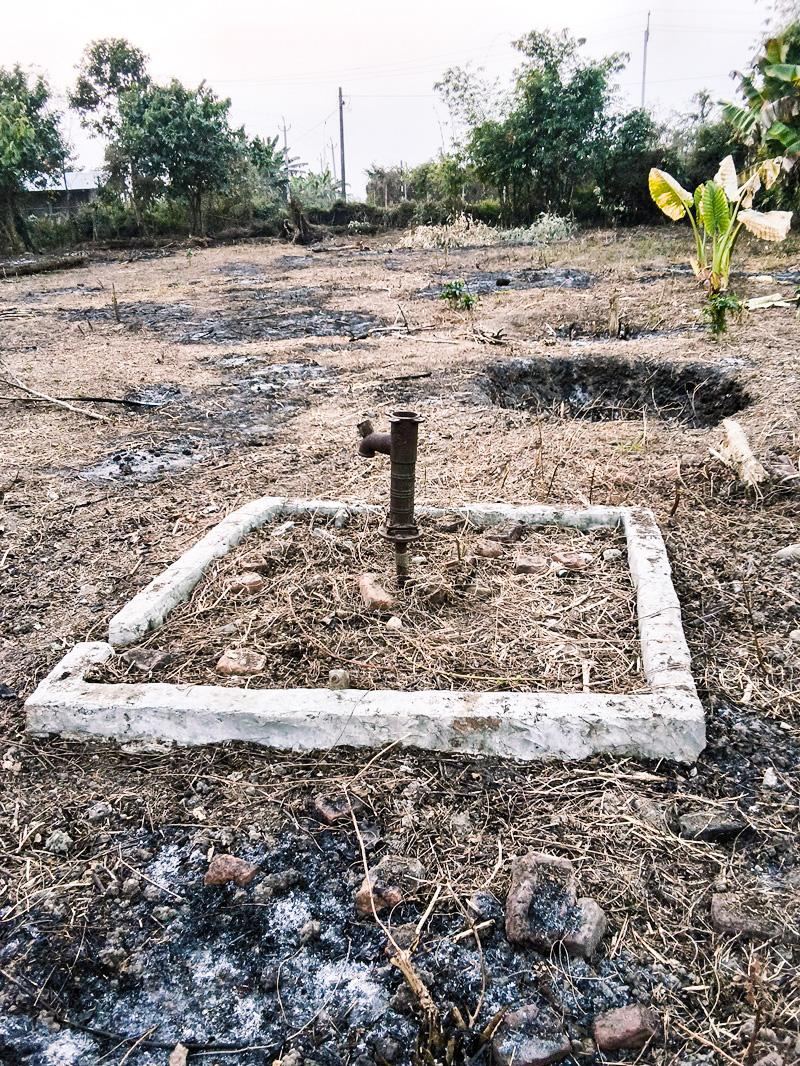
Photo : Gaurav Das
To Hazarika this meant that in the real time back then affected families, including children stayed in relief camps for extended periods without institutional psychological care following a major industrial disaster.
For a professional like him in this field the RTI queries raised a larger policy issue. “Industrial disaster response in India often focuses on containment, compensation and environmental restoration, but neglects long-term human trauma. The absence of an MHPSS response in one of India’s largest gas-well disasters suggests a systemic gap in disaster governance rather than an isolated lapse,” said he.
In a lamenting note he summed it up as, “This information came only after a full appellate process before the Central Information Commission, nearly 16 months after the original application.”
The aftermath of the blowout and the ensuing devastation had to be reckoned with. The intensities ushered by the blowout’s occurrence and its impact on all matters organic as highlighted by Yadav’s report states it all.
The report’s chapter titled ‘Soil and Water Pollution’ detailed key affected changes on the local environment post blowout.
Some of the key changes as noted by the report were:
“Water pollution at places found to be higher than 5°C, which is categorized as thermal pollution” (sic)
“Breach was found in respect of amount of oil and grease in water and soil” (sic)
“Drone based assessment of damaged areas in a 3 km radius. Total affected area came to 58.8 square km” (sic)
Manoj Hazarika is the village headman of Baghjan village. Besides the six-hundred-plus victims, who faced the brunt directly and collaterally, Hazarika and his ilk were at the forefront of the vehement protests against the “callous attitude” of a behemoth national company of OIL.
Decked in his office were tiers of official documents. “I am a government representative now. The fire has long been exhausted. But the scars remain etched in our souls. I am a victim. The blowout’s repercussions are still expanding. The betel trees in my ancestral backyard can tell a story about it. Areca seeds’ yield has diminished over the few years since the poring of condensate all over the territory,” said Hazarika.
Hazarika was put in the jail for seventeen days. There were nine charges levied against him. He said that there were twenty-six people were immediately put under non-bailable offenses.
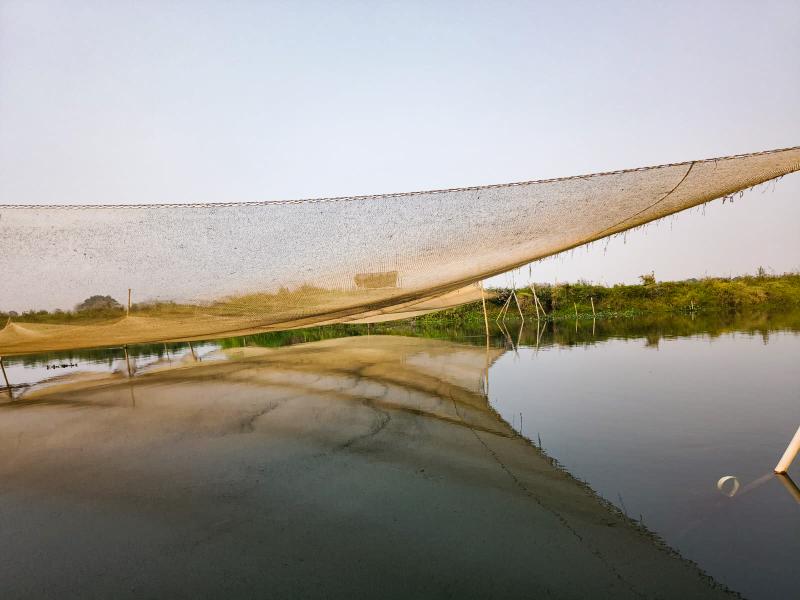
Photo : Gaurav Das
To combat a fossil-fuel behemoth of a national company Hazarika and the victims had to resort to pooling of resources to battle OIL in courts and tribunals. The victims had to be uniformed under sprouted village organizations, and this meant collecting money for a legal team-up.
“It’s a matter of acute labour-enduring task to fight legal battles. Can you imagine fighting a legal battle from Baghjan to the court rooms in New Delhi. We are as of now fighting for the allocation of final compensation. The four-year fight amounted to Rs 16 lakh/. There were setbacks and I personally faced scathing-words from victims,” he added.
The villagers had all gathered at the village namghar in 2021 for a final resolution in combating OIL at the courts. Hazarika said toward the end of 2021 he went to Delhi. In the initial phase Rs 500 were collected from around 250 affected villagers.
Now, as a government representative Hazarika shared with this reporter that he is “getting pulled from both sides”-surmounting pressures from OIL/government and from the victims’ families.
“Its almost six years after the tragedy. I still haven’t set foot inside OIL’s office. I am fifty-years old. I need to stay fixed in one place. I cant put my two feet on two boats. The experience for me is totally Kafkaesque. Fighting for justice meant getting pushed around from one bureaucratic department to another, like a ball. Labanya Saikia is the face of the present battle, and she has to fight it,” said he.
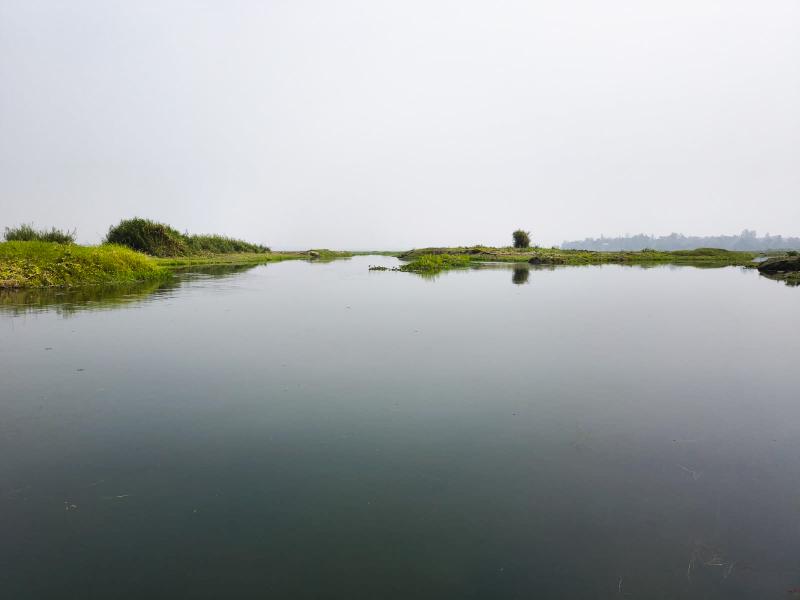
Photo : Gaurav Das
The village headman cited that there are around fifty-plus wells in and around the area. “We are all sitting on multiple pressure points. If our only had been a different state, thing would have been quite different from what is being played out as of now,” said he.
On being asked what prospects Baghjan holds especially with state assembly elections just around the corner a smirk appeared on his lips.
Crossing his arms and with a confident tone he said, “Baghjan can never be an election issue. Till now we’ve been all alone in our fight, and we’ll remain so.”
So, what remains for legal recourse in the present time? The conundrum overcompensation still persists and is quite complex in nature.
Niranta Gohain, a tour consultant, and an inhabitant of an adjoining village named Natun Rangagora (Natungaon) had filed a PIL almost a month later after the blowout. His PIL in the National Green Tribunal (NGT) had hopes of being a lucrative legal recourse. But he was told his PIL “was quite early”.
This reporter reached out to an expert closely observing the legal scenario of the present battle and the legal entailments of the complex compensation process. The expert on the basis of anonymity stated as such:
“The initial doled out compensation were that, in the first bracket the 12 severely affected families got Rs 25 lakh, 161 families out of 600 families got Rs 15 lakh, and in the third bracket included 439 families.”
A committee of experts under Justice BP Katakey was constituted by the NGT based on the constituted vide order of 24/06/20 which was passed on OA 43/2020 EZ which was filed prima facie by Bonani Kakkar, and OA/44/2020 EZ.
Accordingly, there different categories were formed for dispensing compensation. The committee was formed on June 24, 2020.
The expert observer continued as,
“The committee then suggested the interim compensation which was accepted by the NGT. Meanwhile, in the same course of time there were several meetings during which 600 victims and the 12 severely affected victims’ families were added, and the categories were redefined. Now, accordingly to the results of those meetings the redefined categories were Category 1=161 families got an amount of Rs 15 lakh/, and Category II= 439 families that got an amount of Rs 10 lakh/.”
The expert then said it was after this that confusion over the compensation process prevailed.
Photo : Gaurav Das
“Now, the interim NGT order based on the Katakey committee recommendation three categories were doled out. The categories being as such: Category 1=Rs 25 lakh, Category II=Rs 10 lakh/, and Category III=Rs 2.5 lakh/ as defined by the Justice BP Katakey committee in the ‘Progress Report’ (Volume 1).”
He then marked that as the battle over the compensation raged on the victims couldn’t represent themselves.
“Simultaneously, another assessment was being put forwarded during a tripartite meeting between OIL, Milan Jyoti Sangha, and the Tinsukia district administration. The meeting was held in 2020. A decision was taken under which: 161 families would get Rs 15 lakh as ‘advance’ in category 1, and in category II 439 families would get Rs 10 lakh as advance”
“Subsequently, both the parties will ger Rs 10 lakh/more. That was the demand in the tripartite meeting. And the demand was accepted by the Tinsukia DC, who was incidentally a member of the expert committee, and this part was recommended to the NGT.”
On February 19, 2021, the NGT closed the original application (OA) more or less stating that, “OIL has accepted the responsibility and is not willing to accept more liability.”
“This part was challenged by Bonani Kakkar in the Supreme Court challenging the NGT order. It is to be noted that after this setback in the SC, the victims along with Niranta Gohain and the legal team with Manoj Hazarika included, joined the fight in the SC with Civil Appeal no: 2201/2021.
Now, the SC on January 23, 2023, allowed it to participate, and it bifurcated the issue of compensation into two parts: Part A being Interim Compensation, and Part B related to Final Compensation.”
An activist said, “It was thought upon that we will go for the interim compensation, and it should be disbursed by the authority concerned, i.e. the DC, within two months and regarding the final compensation the NGT was granted the liberty to determine the modalities for adjudication of final compensation and its disbursement.”
The activist then continued as, “Then we submitted a representation to the DC. After that there was no response from the district administration whatsoever. Then we filed a contempt petition (Civil) no:1943/2023 in the SC. The SC directed us to approach the principal bench”.
On August 8, 2023, a three-member NGT bench ordered to disburse the interim compensation and ordered the applicants to approach the DC again.
“So, again we submitted a representation to the DC of Tinsukia. He didn’t do a thing, and there was no disbursement. So, we filed a Miscellaneous Application MA 31/2023 only for Baghjan at NGT, EZ, and another MA 33/2023 for Natun Rangagora alone.”
It is to be noted that the hearing for interim compensation pertaining to MA 33/2023 is fixed for a final hearing in April, according to the activist.
He again continued as, “On December 13, 2024, the NGT disposed off the claim for an interim compensation. But, at the same time, the NGT kept open the Final Compensation part, provided the evidence of the wholesome damages that have incurred by the victims.”
According to the activist a civil appeal was filed in the SC number 13483/2025. This was disposed-off on May 9, 2025.
“The SC observed that the issue of final compensation is open, and so now no further direction is needed. The option is left open. And we have filed an application in the NGT EZ for the 12 families,” said he.
To sum it up as of now five families whose houses were severely destroyed got Rs 25 lakh as interim compensation, and seven families whose damages were sizeable got Rs 15 lakh/ as interim compensation.
Now, the 12 families are categorized as 1, and the 161 and 439 families as in Category 2, as per the NGT order of December 13, 2024.
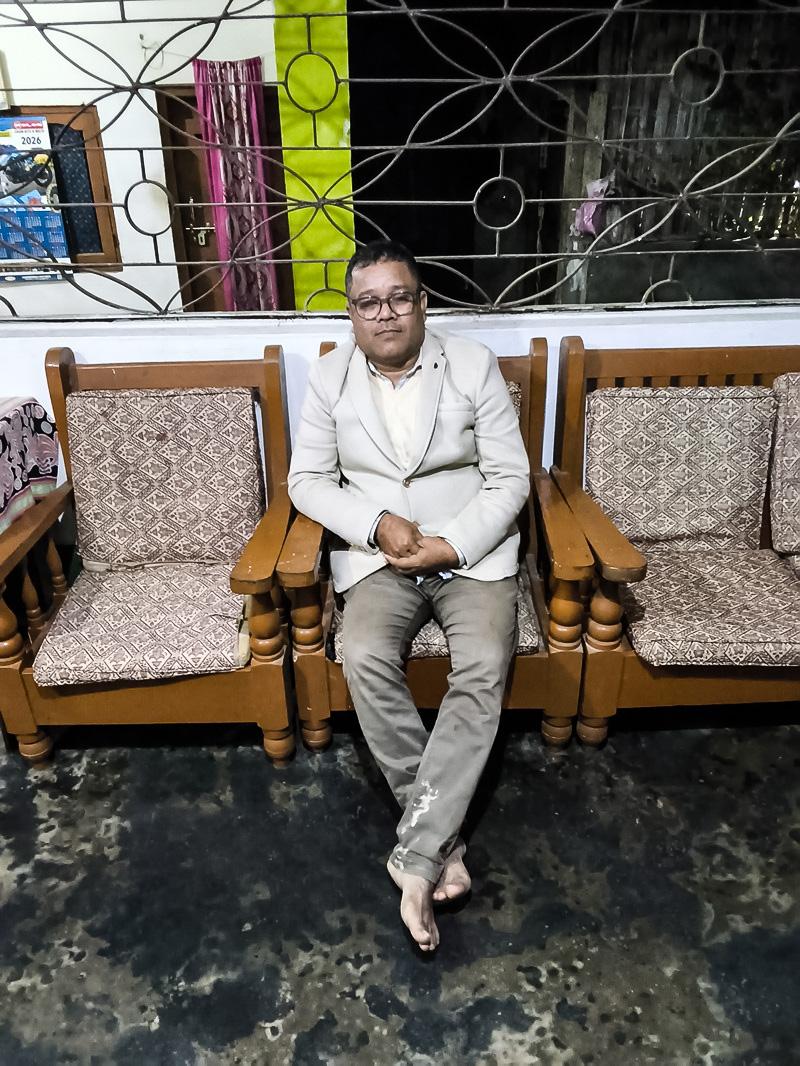
Manoj Hazarika, the Headman of Baghjan village. Photo - Gaurav Das
Manoj Hazarika said, “Now the issue of final compensation is open how do you expect the victims to come to Kolkata. The main question is how the victims will organize evidence of their properties’ destruction.”
He hinted at the expertise and expenses required to collect scientific evidence. “Who will provide the victims with the resources. The interim compensation is based on estimate while the final compensation is based on documentary evidence. The various researchers who did their filed studies on the range of destruction need to come forward and help the victims,” he stated.
The activist reminded, “What about the Rs2.5 lakh/ under category III? A sizeable amount of people who incurred losses were not identified by the district administration.”
The expert and the activist highlighted that only if a committee is formed with a proper Tinsukia-based framework setup for the victims vying for the final compensation and for placing the modalities with a firm structure so that the victims are able to get proper accessibility to submit their evidence, things would have been a lot feasible.
“This is not happening as of now, sadly,” said Gohain.
He then added, “Due to growing uncertainty, many villagers are considering leaving their ancestral homes. However, poverty prevents them from relocating. Financial hardship forces some families into desperate measures just to survive. Unemployment among local youth has increased. With limited options, some are compelled to depend on oil-related activities for small earnings. This economic dependency is slowly affecting the social and moral fabric of the community. At the same time, new oil exploration activities continue in the region, raising further concerns about environmental safety and long-term sustainability,” said he.
For him, Hazarika, Labanya and the legal expert if the situation continues the same the next 20 to 25 years may bring irreversible damage — not only to the environment but also to the cultural and indigenous heritage of the region.
Without proper compensation, rehabilitation and environmental restoration, the future of Baghjan’s villages remains uncertain and fragile, they stated and agreed in unison.
Gaurav Das
A Field based reporting from Guijan and Baghjan in North Tinsukia
|
|
 Navigations
  Quick Contact
 Subscribe Us
 Quick Mail